
By Marie Difolco, author of ‘Supporting Colour Blindness in Education and Beyond‘
When people think about allergy safety in schools, they rightly think about training, Individual Healthcare Plans, clear labelling and access to adrenaline devices. What they do not usually think about is colour blindness.
They should.
My son has a severe peanut allergy and carries adrenaline auto-injectors with him at all times. He is also colour blind. Living with both has made me acutely aware of a safety issue that is often missed: allergy information is often presented in ways that place too much weight on colour, contrast and visual cues that may not be accessible to everyone who needs to understand them.
Colour blindness, also known as Colour Vision Deficiency (CVD), is a non-visible visual disability affecting around 1 in 12 boys and 1 in 200 girls. Around 3 million people in the UK alone are colour blind. In schools, that works out at roughly one child in every average co-educational classroom of 30. Yet most schools cannot identify many of their pupils who have it, because routine screening for colour blindness was removed around 2009. Allergy safety is just one more reason it should be reinstated.
Colour is often used to warn, instruct and identify risk. In schools, allergy information may appear in colour-coded lunch systems, stickers, labels, charts, menus or emergency information. Where that information is conveyed in ways that are not accessible, a colour blind pupil or member of staff might not interpret it safely or reliably or may not be able to read it at all. But the risk does not end there. In school kitchens, Food Tech rooms and restaurants, colour is also often used to separate equipment and supposedly reduce the risk of cross-contamination. If those systems depend on colour to distinguish one item from another, the wrong equipment could easily be used. In that situation, the danger is not limited to the person who is colour blind. It can put any child, member of staff or customer with an allergy at risk.
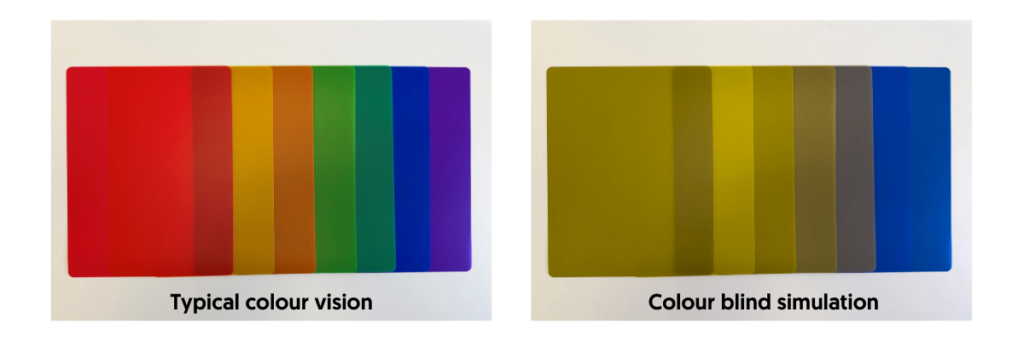
None of this is theoretical. In my book, Supporting Colour Blindness in Education and Beyond, I explain that some text and background combinations, such as black on red, can be extremely difficult for some colour blind people to read, if not impossible. Add in colour coding, small print, shiny packaging and time pressure, and the chance of error increases.
This issue extends far beyond schools. I recently contributed to published correspondence on colour vision deficiency in anaesthetic areas, which highlights how inaccessible colour coding in clinical environments can affect staff as well as patients. That matters hugely in the context of allergy too. We do not want clinicians, school staff or anyone else misreading colour-coded information where medication and emergency care are involved.
The good news is that the solution is simple. Never rely on colour alone to communicate medical or allergy information. Clear words, strong contrast and symbols should always be used alongside colour. Individual Healthcare Plans should also record any additional access needs that affect safe self-management, including colour blindness.
If we are serious about allergy safety, we must also be serious about accessible communication. Teachers are not usually trained to spot or support children with colour blindness in the classroom, and it is vital that they are. But the problem does not stop with education. Colour blindness is still poorly understood in workplaces, just as allergies are too often misunderstood or underestimated. When colour is not accessible, it affects both learning and safety. People with allergies and people with colour blindness are not always separate groups. Sometimes they are the same person. But even when they are not, the risk remains.
If colour-led systems fail, allergy safety fails too.
Many children with colour blindness do not realise they have it, because they have always seen the world this way and may not recognise that their experience of colour is different. This can make it very difficult for them to explain or advocate for their needs. Screening is quick and simple and can be arranged through any high street optician, typically using an Ishihara plate test. However, it is important to request a colour vision test specifically, as it is not always included as part of a routine eye examination. Early identification is important for both learning and safety, particularly as colour blindness can co-exist with other SEND and medical conditions such as allergies.
Marie Difolco is an author, speaker and campaigner for safer, more accessible use of colour. She is the author of the not-for-profit book Supporting Colour Blindness in Education and Beyond and has spent more than a decade raising awareness of colour blindness. She writes from both professional and lived experience as the parent of a child with colour blindness and a severe peanut allergy.
Sources: